|

|
How to design and handle a FFW programme?
Principle steps and mechanisms
Whether a FFW programme is justified or not depends on the overall objective and strategies, as well as the local circumstances within the programme region. In the context of GTZ supported IFSPs, food-for-work activities are the tool to bridge foodstuff deficits in the short–term and they intend to mobilise self-help capacities in food related areas (infrastructure,training and education, production).
Alternatives to FFW within Public Work Programmes are other income transfers such as cash or materials such as seeds and tools. However, within IFSPs these are less important. Whether the payment is in kind or in cash depends on local circumstances. This method describes only the steps required in order to design FFW programmes in the context of Integrated Food Security.
Step 1: What are the objectives of the FFW activities?
- Before FFW programmes can start, the following issues have to be clarified in order to determine the objectives of the FFW measures:
a) The food security or poverty problem of the target population and its causes (e.g. acute food shortage, due to harvest losses, crises, forced internal displacement, or chronic food insecurity due to poverty, structural underemployment, weak or unequally distributed resources).
b) The aim of the FFW programme (i.e. relief, rehabilitation, development).
c) The type of the asset to be created (i.e. directly productive, economic or social infrastructure).
d) The FFW approach, such as large-scale labour intensive, community developmental, agricultural resettlement etc.
- The most applicable FFW approach within GTZ supported Integrated Food Security Programmes is the community project approach for rehabilitation of productive infrastructure through self-help and participation of the community. Emphasis is given to the involvement of local leaders and organisations during FFW activities. Therefore, food, nutritional and organisational aspects are combined to establish community-based initiatives towards sustainable food security within the project area.
- Regardless of the type of projects and measures to be promoted by FFW within an Integrated Food Security Programme, the general objective is always the improvement of the food security situation of the involved families.
Step 2: What are typical target groups for the FFW programme?
- There are two different scenarios where target groups can be identified for FFW activities:
a) Acute emergency situations, as a consequence of war or natural disasters, where people have lost their productive resources, depending on coping and survival strategies.
b) Structural chronic food insecure areas with low self-help potential, as a consequence of structural land shortage, weak productive potential, unemployment or limited access to markets and services which causes poverty.
- Typical target groups within IFSP in rural, urban or sub-urban areas are:
a) Landless families or families with restricted access to land.
b) Migrants, due to the lack of own resources.
c) Unemployed, underemployed and poor people.
d) Young people without any job opportunities.
e) Female-headed households, single-headed households. Recently, the GTZ has begun to concentrate IFSPs in countries and regions involved in conflict or post-war phases. The specific target groups within these areas are mainly internally displaced people (IDP) as a result of wars, conflicts and disasters. They are also the most needy, in terms of rehabilitating their social and productive resources and assets.
Step 3: Determine the situation and areas where FFW will be applied
- FFW activities intend to create economic or social assets for long-term purposes and improve food security within the target population. This implies the need to identify the scope and magnitude of the nutritional problem (i.e. the determinants and prevalences of the food insecurity problem in the region). Furthermore, the general conditions of the communities should be known in terms of resources, potentials and institutional capacities.
Step 4: How to select FFW projects or measures? Define criteria
- Once the nutritional problem is characterised within the programme areas, specific FFW activities can be developed.
- If harvest losses occur due to seasonal droughts and the stored grains have been consumed, then FFW activities need to be carried out during the critical pre-harvest period. However, what has to be avoided is that the FFW is undertaken at the same time as agricultural labour activities are at their peak, since this causes competition for labour.
- Where damaged or poor irrigation systems exists FFWs could provide the necessary incentive for rehabilitation or improvement. This will lead to improved agricultural productivity and diversification, and may also increase the number of harvests possible.
- Communities often have prioritised small-scale projects for which they may only require a small incentive, in form of materials or tools, in order to commence. It is important that FFW takes the prioritised community needs and requirements into consideration for FFW actions.
Step 5: How to select the participants for the FFW activities? Define criteria
- Regardless of the variety of possible community-based projects, which could be implemented though FFW, clear criteria should be defined to involve only the poor and food insecure families or household members in the FFW programme.
- These selection criteria for an appropriate targeting of the population have to be discussed and accepted by the community. Some general aspects, such as the willingness to self-help, a minimum of social organisation, and the potential to contribute to the long-term and maintenance costs of a project, are common pre-conditions of a FFW programme.
- When the community organisation is established and the participants for FFW activities have been selected, it is necessary to define objective indicators to determine food insecurity. The following indicators may prove helpful in this task:
a) The nutritional status of children or adults within the family.
b) Socio-economic status of the families.
c) Unemployment rates.
d) Information regarding land-ownership patterns.
e) Registered migrants, displaced or affected people due to conflict or natural disasters.
- It has to be remembered that sick or disabled people, children or elderly, who are physically weak, cannot participate in the FFW activities and only benefit indirectly from the distributed food rations within the households. These specific target groups need particular programmes and interventions, depending on the identified problem of this particular population.
- Note: There is also a need to consider gender aspects in the design of FFW activities. On the one hand, women should be integrated disproportionately into the FFW programme to ensure that food rations reach the women directly since they are key persons for ensuring food security at the household level. Furthermore, women should be fully integrated into the decision-making process concerning the appropriate food items, the rations, distribution and management procedures. On the other hand, planners need to be aware that FFW activities can increase the overall workload of women, resulting in further negative effects on matters such as childcare. A balance has to be struck between providing benefits from FFW, while mitigating potential negative consequences on women. The manner in which the balance is to be achieved requires intensive discussions amongst programme staff and community members/ leaders involved in FFW activities.
Step 6: Food rations, logistics and working principles
- Generally, each programme defines a standard food ration used in FFW activities. Food rations should cover a part of the daily subsistence requirements for an average household. Furthermore, they should take into account local and country-wide food staples, as well as culturally determined food habits.
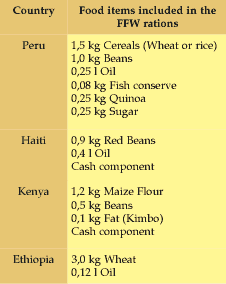
- Food rations can differ between countries and programmes. Table 1 provides some examples from various GTZ supported IFSP.
Table 1: Country-specific examples of FFW rations
|
|

|
- Food rations are normally scheduled to be distributed either on a weekly basis or every two weeks. The rations are always distributed to those who participate in the programme. Even if women do not participate in the FFW activities, they must be involved in the distribution process in order to ensure a high level of transparency. This is necessary to make sure that the women are aware of the food items that will be made available to the household.
- At times, educational aspects need to be integrated into FFW activities. This helps to ensure that the food insecure persons also receive important messages on issues such as nutrition, health, consumption matters, as well as nutritional behavioural factors.
- The number of people, who fulfil the criteria for participation in a FFW programme, can exceed the FFW capacities. One way of solving this dilemma is to introduce a system of rotation that maximises the levels of participation of the needy. Nevertheless, a restriction that has to be introduced is that only one member of a household is allowed to participate in the FFW activity concurrently. This ensures an equitable distribution of benefits per household.
- Normally, food rations are distributed on the basis of work performances and not on the mere basis of attendance. Ideally, FFW activities should take into account country specific work norms.
Step 7: Monitoring and Supervision of FFW activities
- Generally, FFW can be deemed successful and appropriate if it has maximised the number of people who were involved in the activities and fulfil the criteria of being food deficit, poor or unemployed. It is not only a question of participating in any activity, but rather a labour intensive activity that creates productive and socially relevant assets for the community. All of this requires careful monitoring and intensive supervision.
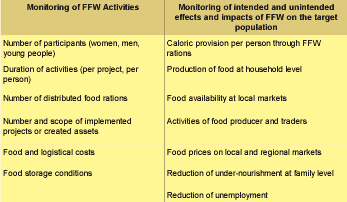
- A clear distinction has to be made between monitoring the FFW inputs and activities, and the monitoring of the intended and unintended effects and impacts. The following table provides some examples of factors that need to be considered in any FFW monitoring system.
Table 2: Examples of indicators for monitoring systems
A coherent FFW design can help to establish the internal programme monitoring scheme, and contributes effectively to the objectives and indicators of the overall monitoring and evaluation system necessary for a Integrated Food Security Programme. |