|

|
A basic model for curriculum / syllabus development
Verduin’s model (1980) was developed to document and guide a system of curriculum / syllabus development that was used in urban adult education centres. It recognizes the peculiar needs of adult learners. The model can be applied to different sectors, including the forestry sector. The approach promoted by Verduin includes taking the “learners” from where they are in life to where they need to be according to the organisations and their individual perspectives.
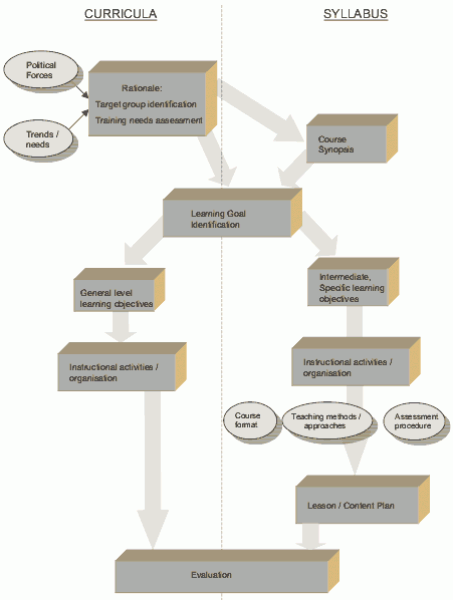
Verduin’s model has five major elements: rationale, outside political forces, goal identification, instructional activities and organization, and evaluation. These elements all have sub-elements. The description contained in these guidelines depict Verduin’s model in terms of how they relate to curriculum / syllabus development for forestry management.
Figure 1: Inter-relationship: Curricula / Syllabus & Verduin’s five elements
|
|

|
1. Rationale
The first element of curriculum planning is that of the rationale, or explaining why a curriculum is being developed or revised. However, for the subject syllabi the rationale is included in the synopsis. In Forestry, one can take the rationale directly from the people to be trained. One of the core beliefs of a hallmark of good curriculum development is that one develops long-term relationships with “clients” to move them through a training stream. For example, learners may start with the Foresters Certificate and move through Forest Rangers. A successful curriculum takes learners from where they are and moves them to where they need to be to meet their own and the organisations goals. The rationale has two steps: target group identification and needs assessment of trainees has to be included in a training course.
- Target Group Identification. It is critical to identify the primary target group to be reached through the training course. The more one knows about the target group and the more specific target group has been identified, the better it is to design a curricula or syllabus that best meets their needs. In Forestry one may have dealt with Foresters in the past, in future private plantations owner and other target groups may be added. In this case the curricula / syllabus would need to be adapted according to the target groups needs and requirements. The first step that needs to be undertaken is to get to know the target group and to understand their motivation for learning. Often training courses may target two or more diverse target groups. It is then important to understand the differences between the groups and design training courses to meet both sets of needs.
- Needs Assessment. Needs assessments can be formal or informal. It is periodically advantageous to conduct formal needs assessments for the forestry sector. When working with a new professional picture of say the Forest Rangers that also embrace their role in the private sector, and then it is mandatory to conduct a formal needs assessment. Informal needs assessments can be conducted by keeping one’s ear to the ground, visiting potential employers of the Foresters and Forest Rangers.
2. Political Forces
It may also be worthwhile thinking through the effects of outside political forces to act as modifiers between rationale and goals. This is particularly appropriate for Forest management where the identified target audience needs must be harmonized with the desires of powerful outside forces. Three types of outside forces operating on the syllabus / curriculum development process include government agencies, private organizations, and non-governmental organizations.
- Government Agencies. Regulations and legal requirements are regularly imposed upon the forestry professionals. The effects that the Acts have on the forestry sector (for example the privatisation efforts) as well as external factors such as the desire to pursue the ISO 9002 or the standards means that the curriculum and syllabus needs to be constantly revised.
- Private Organizations. Curricula and syllabus contents can be affected by private organizations in a variety of ways. Private forestry sector on the timber and non-timber sectors can set the technical standards associated with a certain skill set. For example, private log millers may establish and use the standards that govern the ways that forest products are measured. A training programme in forest measurements needs to account for these rules, and the need for new training programmes may arise when new rules are put into place. Market forces can be significant factors in the need for and type of training programme developed.
- NGOs. Non-governmental organizations such as environmental groups can have major impacts on the demand for continuing training programmes. One example of this is through the establishment of sustainable development criteria that drive much present-day management. Other NGOs are important for funding continuing training programmes.
3. Learning Goal Identification
The most important element in a curriculum development model is the goal identification. Learning activities are developed as specific responses to goal statements. The process of defining the goal statements determines what will be taught and what will not. It also determines how easy it will be to evaluate what is learned. Goals give curriculum developers targets to shoot for. Learning activities are attempts to hit those targets and evaluations are measures to see how many targets were hit. Three levels of goals can be set for curriculum: general goals, intermediate goals, and specific goals. Similar hierarchy of goals can also be set for the subject syllabus.
- General Level (Abstract). These goals are the guiding principles behind large-scale training courses. For instance, the Forestry course may have 1-2 general goals. One could be: sustainable management of the Forests.
- Intermediate Level (Course/Subject Level/Measurable Objectives). These goals are generally responsible for driving the training course or subject level. They are generally simple statements of what subject’s participants will learn in a particular course. It is very important to state these goals in measurable terms. This can be done by making them active imperatives with the learner as the subject and a statement of quality as the ending. For example: Learners will be able to estimate the volume of timber in a stand by taking plots to measure height, diameter, and number of trees per acre, using diameter tapes, clinometers, loggers tapes as tools, or using a computer course to perform their calculations and be within 5 percent of the instructor’s estimate.
- Specific Level (Class Session Level / Measurable Objectives). These are very task-oriented goals and relate to small discrete pieces of learning that must take place to achieve mid-level goals. These goals are often not enumerated in detail, but are left to be derived from the mid-level goals. An example of a specific-level goal would be to learn to identify the three particle sizes used in soil classification of sand, silt, and clay.
4. Instructional Activities and Organisation
The development and organization of instructional activities is the central part of the development of the curriculum and syllabus. While it will be broadly only broadly defined in the curriculum it will be much more detailed in the subject syllabus. If trainers and managers are thorough in their goal development, then the selection, development, and organization of instructional activities is a fairly straightforward process:
- Develop or use specific learning experiences to achieve goals at all three levels. Like goals, learning experiences are hierarchical. Specific learning experiences that will cover a class session or two are the building blocks of syllabus and serve specific-level goals. Together these specific-level experiences make up the learning experiences of a course or subjects and serve a series of mid-level goals.
- Need to recognize hierarchy of knowledge, attitudes, skills, and abilities (KASA). Learning covers different sorts of material. Knowledge learning requires acquisition of knowledge or facts. Knowledge learning is the basis of all learning. Ability learning involves manipulation of knowledge through synthesis and prediction. Ability learning is a higher order learning than knowledge learning, because knowledge is a first step to developing abilities. Skills’ learning is the practical application of knowledge and ability learning. Skill learning is very hands-on and is viewed by some as being basic.
- Need to know or assume entry-level of KASA performance to design appropriate instruction. Each subject syllabus within a training course needs to assume an entry level of KASA. Knowing or assuming where Foresters and Forest rangers who will be trained are allows the trainers to design instructional activities to take the students where they need to be.
- Use prerequisites to try and get entry-level KASA performance. In training, students are not always long-term learners as they would be in a university or college courses. Therefore, it is very important to use define prerequisite classes or skills to ensure entry-level KASA performance.
5. Evaluation
The final step in the model of both the curriculum for a whole course and subject syllabus development is evaluation. This can be used to measure student and teacher achievement, to give feed back to learning activities, and to determine the effectiveness of broad educational courses.
- Measure goal achievement. Goals that are well developed and described in measurable ways are fairly easy to evaluate. The achievement of these goals by learners can be measured using a pre- and post-tests. The results of this evaluation can be used to improve the courses. In another setting, these results could have been used to grade learners.
- Formative evaluation. Formative evaluations are done during an educational course with a goal of improving course decisions. Formative evaluations are often used to measure intermediate student achievement of learning objectives.
- Summative evaluation. Summative evaluations are more formal and seek to evaluate course effectiveness. The evaluations are undertaken by assessing achievement of course objectives and course impact . Various levels of summative course evaluations are used. These levels comprise a hierarchy; the higher the level achieved in a summative evaluation, the more information the trainer will have regarding course effectiveness:
- Inputs level evaluation looks at the resources necessary to conduct a course.
- Activities level consists of listing the activities involved in conducting the course.
- Involvement level lists the number and type of participants in a course.
- Reactions level characterizes the response or reaction of learners to a course and the instructor.
- KASA change level attempts to measure changes in the knowledge, attitude, skills, and abilities of the students.
- Practice change level looks at behaviour changes in the learners because of an educational experience.
- End results level attempts to see if the overall broadest programme objectives are met. In other words, is the world a better place because of the forestry certificate training programme?
Process approach:
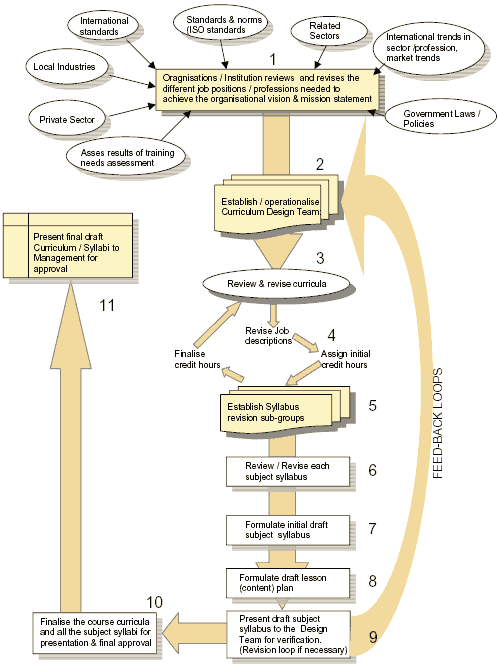
Before planning or reviewing any certificate course, several issues have to be addressed. The development of both the curriculum and the syllabus should be undertaken in a participatory manner. The exercise should not be undertaken merely by the upper management of an organisations but should involve the management, the trainers and the professionals working in the field. A step-by-step approach is being proposed and these have also been depicted in figure 2:
Step 1 - Review of positions in the Department:
Organisational / institutional management needs to assess and review all of the job positions in the department with respect to the ability to meet the vision and goals of the department. The review would need to take into consideration both internal and external factors, including the changes taking place in the forestry profession, the increasing role of the private sector, ISO 9002, results of the training needs assessment and so on.
Step 2 - Establish a Curriculum Design Team:
The proposal would be to establish a Curriculum Design Team. The team should be made up of members from the training institute, representatives from industry and private sector along with lecturers and professional from the field. Consideration should be also possibly given of integrating an “independent” forestry professional, a representative of the human resource department of the organisation and also an instructional design expert. This person would be responsible for assisting to match the best pedagogical approaches with the resources available to the training institution. The team would be the main “working” body charged by the management of the organisation to ensure that the whole curricula are reviewed and revised.
Figure 2: Curriculum / syllabus stakeholder participation process

|
 |
Step 3 - Review / Revise the Curricula:
On the basis of the recommendations made by senior management of organisation / institution, the Curricula Design Team would revise and update the course curricula. The team would make use of all available information on the training needs, including the any training needs assessment. The team would undertake a systematic review of the curricula for the whole certificate courses, including all of the various subjects that would have to be covered in the curriculum. The team will allocate the initial credit hours for each subject. This will only be indicative initially and will be finalized once all the subject syllabi have been completed.
Step 4 - Define Job Descriptions and Assign Credit Hours:
The team could also assist in the process of defining proper job descriptions for the relevant positions defined by the management of the organisation / institution, this may prove useful in defining the training needs and thus the curricula of the course. In addition, the Curricula Design Team could assign the initial credit hours that will be allocated to each of the subjects defined in the curricula.
Step 5 - Establish sub-team to elaborate the subject syllabus:
Once all the subjects have been defined, then sub-teams can be formed who will be charged with the task of reviewing and revising the syllabi of all of the subjects. The sub-team will formulate the revised syllabi for each subject. Steps 6 - 8 Review syllabus, formulate initial draft subject syllabus and lesson plan:
The sub-team made up of professionals and trainers will develop the subject syllabus. The template attached to this tool kit / guideline may prove useful for this purpose. The sub-teams will also formulate the lesson / content plans for each subject. Each sub-team will also outline the appropriate techniques for assessing student achievement.
Step 9 - Submit initial draft subject syllabus and lesson plan to Curricula Design Team:
Each sub-team will then submit the draft syllabi to the Curriculum design team / board for verification with the curriculum. A feed-back loop between the syllabus sub teams and the Curricula Design Team would be undertaken in which proposed changes would be integrated into the syllabus and duplications and overlaps removed.
Step 10 - Finalise the curricula and syllabi:
The Curricula Design Team would be responsible for ensuring that the subjects are in line with the overall course curricula, that duplications and overlaps have been streamlined and that the course is manageable and can be implemented to the level desired in the given time period.
Step 11 - Submit revised curricula and syllabus to management for approval:
The Curriculum design team would submit the curricula and all of the subject syllabi to the senior management for final approval.
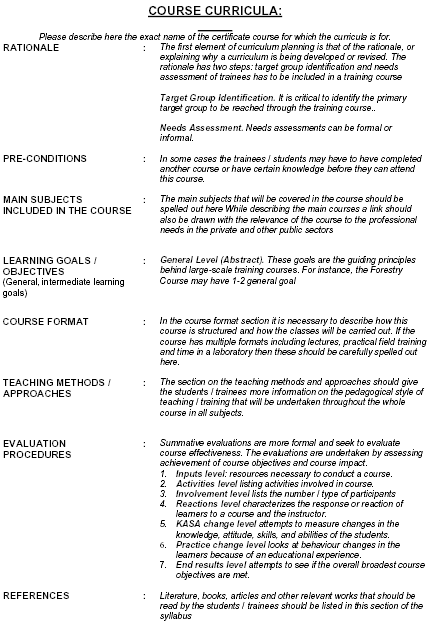
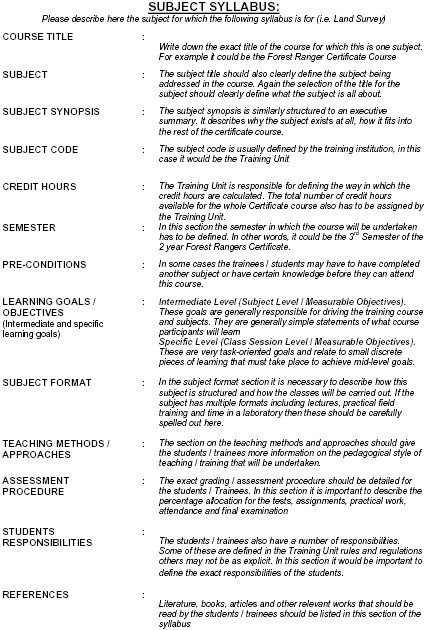
The following templates are designed to guide curricula and syllabus training institutions during the design or revision stage of curricula and syllabi.
|