|
Brief background to RCIW, Nepal
Rural Community Infrastructure Works (RCIW) Programme is a national programme of the HMG Nepal. The overall development objective of RCIW is to improve the livelihoods of the 50,000 households most vulnerable to food insecurity, living in the most food-deficit districts. RCIW’s immediate objectives are to enable poor people to obtain and maintain assets that increase the availability of food and income in their community and the individual households.
The activities of RCIW aim to improve several factors contributing to food security:
- Development, self-help, potential of the RCIW target group population
- Food and income available to households
- Road and trail networks in RCIW intervention areas
- Natural resource base
- Planning, implementation, and operational capacities of RCIW partner organisations.
To achieve this, the RCIW partners provide food grains as temporary assistance to poor households in exchange for labour on Food-for-Work projects. They also provide the local User Committee managing the project with construction materials, farm inputs, tools, technical and managerial expertise, and training to enhance the capacity of the communities.
The integrated approach of RCIW aims to build the capacity of impoverished households and communities in the target group to generate longterm food security. RCIW also aims to improve the capacity to deliver services by providing training and extension aids to private and public organisations and institutions including DDCs, VDCs, locally operating partner NGOs, and consultants.
To achieve its goal of food security, RCIW initiated a complex process that requires the committed endeavours of the government, civil society, private sector, and international community. Hence, building partnerships is one of the main activities of the RCIW management. It has established partnerships with other donor agencies to extend the coverage and scope of its interventions. To meet the demand of the members of the target group for services and development activities, it is constantly establishing partnerships with various public and private organizations.
At the central level, the three main partners in RCIW (Ministry of Local Development - MLD, World Food Programme - WFP, and German Agency for Technical Cooperation - GTZ-IFSP) have set up and intensified additional partnerships with several donors, projects, and programmes, to enhance the capacity of RCIW to offer technical assistance and financing.
|
 |
RCIW’s quality management needs
Generally, quality management systems are designed in order to meet the quality standards laid down by the management of an organization. It includes the organizational structure, responsibilities, processes and resources required to meet these basic minimum quality standards. The most important concept that has to be introduced to an organization is the establishment of a quality culture that is enshrined in a set of commonly agreed upon standards and principles and in order to ensure their compliance a system for monitoring, maintaining and steering has to be put into place.
RCIW has already undertaken a number of quality assurance measures; these include the production of various strategy papers, the implementation guidelines and other important concept papers. Furthermore, RCIW already implements a monitoring and evaluation system that also includes some elements of quality assurance. This includes regular district, regional and national stakeholder assessments (Participatory Experience Sharing Exercise PESE) and other participatory monitoring approaches. A linkage to quality management of its partnerships prompted the development of the approach elaborated in this paper.
Link to international quality standards
The EFQM model serves as a good starting point for further improving the RCIW quality management system mainly due to:
- Its holistic approach;
- The fact that it views organizations in their own right (autonomous);
- Its dynamic and process oriented approach.
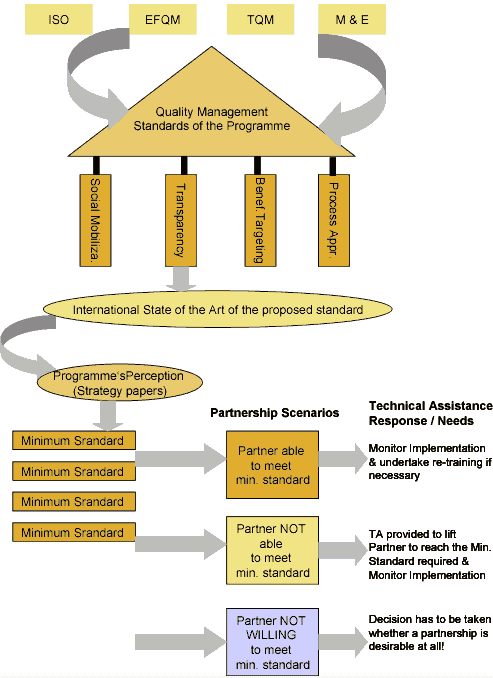
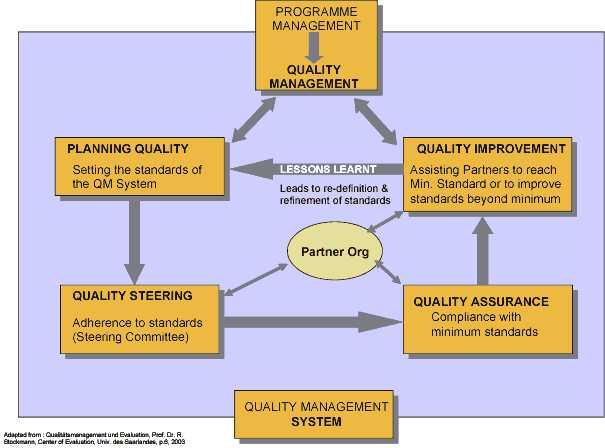
Figure 1 depicts the main elements of RCIW Quality Management System (QM). First and foremost, management has to define the main elements that should make up the quality management system. In this case it means defining the main pillars upon which quality will be measured. Thereafter, the quality management system has to be planned and elaborated, this includes defining the standards for the QM system (this paper provides proposals as to how these minimum standards can be defined).
Quality steering, quality assurance and quality improvement forms a continuous learning and self-improvement cycle. The role of partner organisations is centred around these three elements. On the one hand the partner organisations are expected to adhere and comply with the defined standards. On the other hand, technical assistance will be necessary in order to assist the partner organisations to reach the minimum standards. Together all elements in figure 2 represent the Quality Management System.
Figure 1: Tasks of a quality management system
RCIW-QM: A variation of the EFQM model
The current monitoring and evaluation system of RCIW is geared towards measuring the achievements of what is termed the “results” in the EFQM model. Missing, to a large extent, is a system for determining whether the “enablers” in the EFQM model are of sufficient quality. A 1:1 adoption of the EFQM model is currently unrealistic for several reasons:
- Implementation of the EFQM system would require a considerable amount of TA support;
- Presently, RCIW requirements are more for a “franchising” or partnership quality control system rather than a fully-fledged EFQM system for the whole programme.
Defining and setting minimum standards
RCIW has already been working with what could be termed “minimum quality standards”; however, these have never been defined in an objectively verifiable manner.
Step 1: Underlying Principles of RCIW
The main partners of RCIW have concluded that the following main principles are the most important ones for the programme. Achieving a minimum standard of quality is therefore a must in order to be able to successfully work within the framework of RCIW:
- Transparency
- Social Mobilisation
- Beneficiary Targeting
- Process approach and User Group Implementation
Step 2: Measuring the RCIW minimum standard
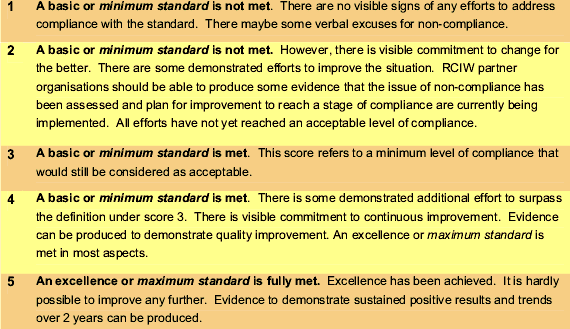
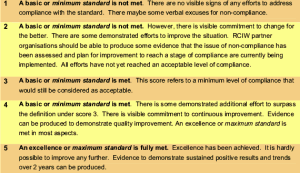
The scoring system of the RCIW checklist is based on a 5-point scoring system. A score of 1 is the lowest score, 5 is the highest possible score. The main question is, to what extend the quality standard or criteria of the standard have been met.
Table 1: Definition of standards
|
 |
Step 4: Defining the quality management indicators for the partnership model
RCIW had defined four main quality indicators for the partnership model: transparency, social mobilisation, beneficiary targeting, process approach anduser group orientation. Step four involved a three stage process: defining international and national principles of the indicator and and then finally elaborating the RCIW definition of the indicator.
Quality Indicator 1:
a) RCIW’s principles of transparency and accountability
According to RCIW’s documents, the programme faces a number of challenges while promoting transparency and accountability, including:
- Reconciling different standards, perceptions and vested interests regarding transparency and accountability among the three main groups if RCIW partners and stakeholders.
- Minimising political pressure in decision-making by politicians, local elites, and bureaucrats.
- Reducing the temptation to misuse power and authority to embezzle funds, and to conduct affairs through nepotism and favouritism
RCIW desire to ensure a high degree of transparency and accountability is needed in order to:
- Ensure that the transfer of large amounts of financial and physical resources (mostly food) is properly accounted and used by the local governments and target groups;
- That the large numbers of contracts that are made between the Government and the numerous service providers (e.g. traders, consultants, etc) are conducted
The overall objective of RCIW’s for pursuing transparency and accountability has been defined as being:
- Minimise misuse and eliminate misappropriation of programme resources
In order to meet this objective, RCIW has introduced a number of different tools and techniques that it and its partner organisations are expected to use, these include: RCIW Guidelines, Public Information Campaigns, WFP’s Vulnerability Analysis and Mapping (VAM), Guidelines regarding the identification and selection of Food for Work projects, Blue Book, Sign and rate boards, Participatory Experience and Sharing Exercises, Public Audits, Official / institutional audits.
b) Selected RCIWs standard on: Transparency and accountability
1. RCIW partners and organisations are in support of a systematic and continuous quality improvement regarding transparency and accountability.
1.1 RCIW partners and organisations have introduced and apply a system for transparent decision making processes at the national, district, village and User Group levels. The minimum standard of such a system includes conducting of regular meetings with the groups during which all-important decisions regarding activities, resource allocation, implementation and accounting are elaborated and discussed by all stakeholders. For stakeholders who are unable to participate in these meetings the minimum standard requires that they be informed about the decisions reached.
1.2 RCIW partners and organisations apply a system that allows equal
participation of all stakeholders during all meetings involving the
partners’ organisations and the stakeholders. The minimum standard
for these meetings includes the need to have at least a ….%
representation of women, dalits, minority groups, ….. attending and
actively participating in the meetings.
1.3 RCIW partners and organisations introduce and ensure the regular use of the Blue Book. The minimum standard is that each Food for Work or User Group maintains a Blue Book for each project that they undertake, that all essential information required in the Blue Book is encompassed in the Blue Book, that it is up to date and the latest event registered in the Blue Book is not older than 3 days ago.
1.4 RCIW partners and organisations introduce and ensure the regular application of Public Audits. The minimum standard is that each user group undertakes at least one public audit per year, during which all sections comprising the target group attend, where critical issues relevant to the target group are discussed (e.g. workers entitlements), allocation and use of funds and materials are presented and discussed.
1.5 RCIW partners and organisations introduce and ensure that Participatory Experience Sharing Exercises (PESE) is undertaken. The minimum standard is that at least one PESE is undertaken per year for each of the Food for Work projects, that representatives from User Groups, VDC and DDC attend the PESE.
1.6 RCIW partners and organisations ensure that regular institutional audits are undertaken. The minimum standard is that an external institutional audit conducted by a mutually agreeable professional(s) is undertaken at least once every …. years. During these external institutional audits the professional has to examine the records of the respective institution according to audit rules and regulations.
Quality indicator 2:
a) RCIW’s principles of social mobilisation
Social mobilisation is a means of transforming target populations from being recipients of benefits to being active participants in development processes. RCIW’s target population is the hungry poor in food-deficit areas of Nepal. The social and economic deprivation of the people with whom RCIW works affects all aspects of their lives and livelihoods, including their self-esteem and their perception of the potential for change. Social mobilisation helps RCIW participants to become aware of and articulate their rights and needs, and to use community organisation to bring about the desired changes.
RCIW defines social mobilisation as the process of enabling women and men to build their potential to improve their quality of life and social and economic well-being. This dynamic process lasts the duration of RCIW’s interaction with a User Group. It aims to:
- Empower the RCIW target population.
- Help the target population organise into self-help groups or User Groups (UGs).
- Develop the self-help capacity of the RCIW target population.
- Enable target groups to make better use of the resources and services provided through RCIW and other service providers.
Social mobilisation in RCIW is a two-part process. Initially, RCIW uses social mobilisation as an organisational tool to facilitate the participation of the target group in FfW construction activities and various other social and economic interventions (e.g. saving-and-credit, agriculture, adult literacy, advocacy, and skill development). All of these activities are essential for achieving RCIW’s objective of generating food security for the poorest people living in the most food deficit districts.
Secondly, through ongoing social mobilisation, RCIW aims to empower a group to assert its right to have the services and inputs that enable group members to participate effectively in the development process. Social mobilisation and group organisation enable target group members to increase their influence on local government bodies and to eventually help others in the community.
RCIW uses the social mobilisation process to facilitate the evolution of groups into self-sustaining bodies that are actively involved in making decisions, determining priorities and implementing development activities. It develops the skills of individuals and builds and strengthens institutions. RCIW supports the social mobilisation process in a given intervention area for up to five years.
b) Selected RCIWs standard on: Social mobilisation
1. RCIW partners and partner organisations are in support of a systematic and continuous quality improvement of the social mobilisation
1.1 RCIW partners and partner organisations work primarily with food deficit communities while promoting social mobilisation. The minimum standard is that any Food for Work or User Group that is formed at least …..% of the people forming or making up the group are classified as food deficit families.
1.2 RCIW partners and partner organisations initiate all User Groups through the initial formation of Food for Work Groups. Thereafter, User Groups may form out of these initial Food for Work Groups. The minimum standard is that the primary group formation at the target population level is a Food for Work Group.
1.3 RCIW partners and partner organisations ensure that the User Groups properly represent all sectors in the community, whereby specific emphasis is given to gender equity. The minimum standard is that within each User Group …..% are women, …..% represent minority groups and that the leadership of the User Groups also has the same levels of representation.
1.4 RCIW partners and partner organisations undertake the social mobilisation according to a commonly agreed upon standard of progression. Six stages of progression form the core of the group formation process. The minimum standard is that a clear exit strategy is agreed upon between the partner organisation and the User Group based upon the graduation process. The exit strategy will be dependent upon the speed with which the mobilisation process can be realistically undertaken, whereby RCIW support for User Groups shall not extend a maximum of five years. With the certification of a User Group to a specific level the partner organisation certifies that the group has reached the required standard.
1.5 RCIW partners and partner organisations ensure that groups formed work according to democratic, participatory principles and that they are politically neutral. The minimum standard is that all Food for Work or User Groups undertakes all decisions in a transparent manner and that all decisions are reached on the basis of consensus. The minimum standard also includes the need that women and men, dalits and other minority groups are represented and that a …..% majority is needed to reach a decision.
1.6 RCIW partners and partner organisations ensure that all group accounts are managed in a transparent way. The minimum standard is that group accounts are included in the Blue Book and that they are publicly audited.
Quality indicator 3: Beneficiary targeting
a) RCIW’s principles of beneficiary targeting
Nepal is coping with a growing problem of food insecurity due to declining agricultural production and increasing population. The on-going conflict is also adding to the problems. For generations, population growth has resulted in the division of family holding until now, they are too small and fragmented to support. The use of improve agricultural inputs is limited due to the lack of rural roads. Irrigation is inadequate despite Nepal’s abundant water resources. In the Terai districts that produce an overall food surplus, it is easier to sell the grains to the Indian market than to the severely food-deficit hill districts. The main factors that contribute to the food insecurity problem in Nepal:
- Declining per capita food production overall;
- Low food availability in some regions due to limited potential for production and unequal distribution as a result of a lack of transportation to and in those areas;
- Low-levels of income.
RCIW strives to assist the most vulnerable and food deficit households, which are usually socially and economically marginalized. Generally, these families possess little or no arable land, are illiterate, and without employment. As people in this situation are only able to cope with getting enough food to survive, it is necessary to provide some external sustenance as food or cash that enables them to give attention to social and economic development activities to build their self-help capacity and assets.
Women play a crucial role in household and national food security. In rural areas, women do most of the work to tend the livestock and grow the crops. They are responsible for preparing, storing, and processing food. Since men do not usually help with household work, women carry very heavy loads for the time-consuming chores of collecting water, fodder for animals, and firewood. Women also do all the household work and raise the children. The recognition and status accorded to women is hardly commensurate with their substantial contributions to household and agricultural production. Women and female children are socially and economically disadvantaged relative to men and male children. Most women in rural areas have little or no access to education, and their opinions are rarely considered. In many households, women eat only after the male family members have had their fill, and they are most likely to be deprived when there are food shortages.
RCIW gender vision: Women are socially and economically empowered, meaning that more women are: better organized, in a position to make decisions, in control of more assets, in greater control of resources.
b) Selected RCIW’s standard on: Beneficiary definition and targeting
1. RCIW partners and partner organisations are in support of a systematic and continuous quality improvement with regard to beneficiary definition and targeting.
1.1 RCIW partners and partner organisations ensure that the target group selected includes the poor and disadvantaged families living in rural areas. The Vulnerability Analysis and Mapping (VAM) can be used to pre-select the target areas. The minimum standard is that the results of the VAM are used to define the districts and VDCs where the highest numbers of food deficit families live.
1.2 RCIW partners and partner organisations overlap the results of the VAM with the Core Projects selected by the VDC and contained within the district development plan. The minimum standard is that the types of Core Projects selected are of the type that enables the food insecure inhabitants and households of such regions and VDC to participate directly and that there is sufficient work for completion in 2-3 fiscal years.
1.3 RCIW partners and partner organisations ensure a proper gender balance is assured in the selection of the beneficiaries. The minimum standard is that at least 40% of User Group members are women.
1.4 RCIW partners and partner organisations ensure socially deprived groups are adequately represented amongst the target population. The minimum standard is that at least …..% of beneficiaries are from socially deprived groups (e.g. Dalits, women headed households etc).
1.5 RCIW partners and partner organisations ensure there are equal rights between men and women. The minimum standard is that equal rights and equal pay for equal work is assured for women and men involved in food for work activities.
1.6 RCIW partners and partner organisations ensure they have staff specialised in gender issues in order to adequately address gender main streaming activities. The minimum standard is that the partner organisations have at least one gender focal person in each area in which they are active.
Quality indicator 4: User group orientation
a) RCIW’s principles of planning and implementation process
RCIW’s integrated food security concept focuses on directly addressing constraints on food availability and people’s access to food. In the short term, RCIW aims to alleviate the temporary food shortages of disadvantaged people through Food-for-Work (FfW) so that they are able to invest time in their own long-term development. It mobilises individuals, groups, and communities to create the productive and social framework, such as roads, plantations, and rural financial systems, required for long-term food security.
RCIW uses Food-for-Work in combination with varying amounts of other interventions and instruments, such as savings-and-credit, the introduction of cash crops, skill development, adult literacy and advocacy activities. It uses social mobilisation as a means to launch these activities. For each User Group, RCIW customises the blend of development interventions and instruments that it uses depending on the:
- Actual problems facing the target groups
- Development potential available, and
- Prevalent socio-political circumstances in the given community or district.
Through ongoing social mobilisation, RCIW aims to enable a group to
assert its right to have the inputs from service providers that make it
possible for the members to participate effectively in the development
process. These self-help groups strive to create a situation where the poor
become empowered socially and economically. RCIW sees the development
process of groups in three stages:
- The formation of primary self-help groups such as FfW User Groups, saving-and-credit groups, Participatory Learning and Action (PLA) groups,
- The graduation of primary self-help groups into community-based organisations (CBOs) that are formally recognised by the DDCs, and
- The alliance of cooperating CBOs into NGOs or cooperatives.
- The User Groups shall be the chief implementers of the project and ownership of such projects shall also lie within these groups and local agencies.
b) Selected RCIW’s standard on: Planning and implementation processes
1. RCIW partners and partner organisations are in support of a systematic and continuous quality improvement with regard to upholding the planning and implementation processes.
1.1 RCIW partners and partner organisations seek to promote labour intensive and locally adapted core and micro projects. The minimum standard is that the core and micro projects are predominantly labour intensive and require at least 80% un-skilled labour and that they make use only of locally available materials.
1.2 RCIW partners and partner organisations ensure that the “backbone approach” that forms the central conceptual approach of RCIW is followed and that a proper mixture between Core projects and Micro projects is maintained. The minimum standard is that up to 20% of resources (food grains and materials) allocated to a district are spent on micro projects.
1.3 RCIW partners and partner organisations uphold the technical standards defined for any physical works that are undertaken by them. The minimum standard is that the partner organisation has a copy of the relevant RCIW technical standards, that they are familiar with the standards and that they agree to implement these standards.
1.4 RCIW partners and partner organisations ensure that User Groups are actively involved in the technical feasibility studies of the Micro Projects. The minimum standard is that the User Group of each proposed Micro Project is involved by DPSU and partner organisations during the technical feasibility assessment stage.
1.5 RCIW partners and partner organisations commit themselves to ensuring that the planning and implementation process defined in the RCIW Guidelines are followed and that they work within the framework of the HMG/N Local Self Government Act. The minimum standard is that all Core Projects that have undergone a feasibility study are submitted to the DDC for approval and the DDC shall forward the approved core project to the National Programme Support Unit (NPSU).
1.6 RCIW partners and partner organisations shall emphasise the need for a sound repair and maintenance concept and approach for both the core and micro projects. The minimum standard is that a repair and maintenance plan is drawn up for all projects by the User Groups/Committees and that they are assisted by the partner organisations in managing the maintenance work.
|