|
Background:
In Nepal, about ten million people cope with frequent food shortages. The poorest people of the society are mostly landless and illiterate. Those who have any land usually consume all of their own harvest within two – four months and then do not have enough food for the lean months, from May to June and November to January. Most of these people are jobless and hence, do not have the income to purchase food. Even if they did, food grains are often not available in the markets of remote hill and highland districts due to inadequate transportation networks and ineffectual food supply systems. In response to these problems, HMG/N initiated the Rural Community Infrastructure Works Programme (RCIW) in 1995 with the assistance of WFP and the German Government. Since 1996, a conflict between insurgents and the government has spread to most districts covered by RCIW. It has had an alarming impact on the lives and livelihoods of the RCIW target population and continuously worsened their food security situation.
RCIW’s immediate objectives are to enable poor people to obtain and maintain assets that increase the availability of food and income in their community and individual households. Each year, it aims to benefit 50,000 of these households through food aid (as Food-for-Work), which improves their short-term food security. RCIW’s sub-objectives are to improve the:
- Food availability in the targeted households for the short and long term,
- Rural road network within the allocated intervention areas,
- Natural resource base of targeted households and communities,
- Capacity of the target group for social and economic development,
- Capacity of private and public service providers to support RCIW activities.
Difference between social and community mobilisation
Social mobilisation is the process of bringing together all stakeholders to raise people’s awareness of and demand for a particular programme (health etc.), to assist in the delivery of resources and services and to strengthen community participation for sustainability and self-reliance. Social mobilisation recognizes that sustainable social and behavioural change requires many levels of involvement—from individual to community to policy and legislative action. Isolated efforts cannot have the same impact as collective ones.
Community mobilisation is the process of engaging communities to identify community priorities, resources, needs and solutions in such a way as to promote representative participation, good governance, accountability and peaceful change. Sustained mobilisation takes place when communities remain active and empowered after the programme ends.
How does RCIW define social mobilisation?
RCIW defines social mobilisation as the process of enabling women and men to build their potential to improve their quality of life and social and economic well-being. This dynamic process lasts the duration of RCIW’s interaction with a User Group. Social mobilisation is a means of transforming target populations from being recipients of benefits to being active participants in development processes. RCIW’s target population is the hungry poor in food-deficit areas of Nepal. The social and economic deprivation of the people with whom RCIW works affects all aspects of their lives and livelihoods, including their self-esteem and their perception of the potential for change. Social mobilisation helps RCIW participants to become aware of and articulate their rights and needs, and to use community organisation to bring about the desired changes. Social mobilisation aims to:
- Empower the RCIW target population.
- Help the target population organise into self-help groups or User Groups (UGs).
- Develop the self-help capacity of the RCIW target population.
- Enable target groups to make better use of the resources and services provided through RCIW and other service providers.
|
 |
Social Mobilisation: A two-part process
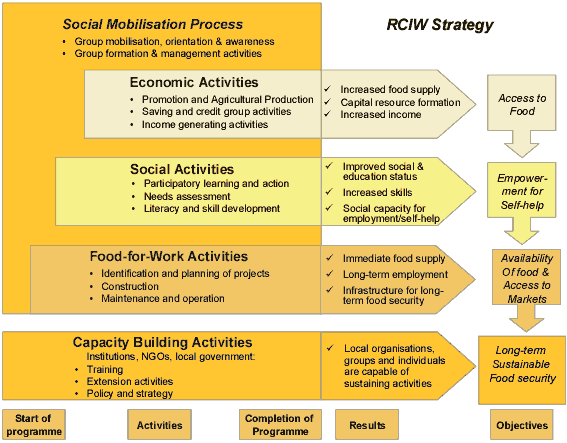
Social mobilisation in RCIW is a two-part process. Initially, RCIW uses social mobilisation as an organisational tool to facilitate the participation of the target group in FfW construction activities and various other social and economic interventions (e.g. saving-and-credit, agriculture, adult literacy, advocacy, and skill development). All of these activities are essential for achieving RCIW’s objective of generating food security for the poorest people living in the most food deficit districts.
Secondly, through ongoing social mobilisation, RCIW aims to empower a group to assert its right to have the services and inputs that enable group members to participate effectively in the development process. Social mobilisation and group organisation enable target group members to increase their influence on local government bodies and to eventually help others in the community.
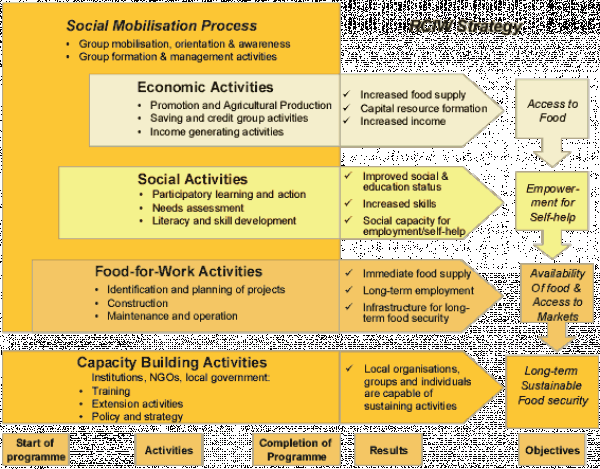
Figure 1: RCIW Strategy, activities and results
For each User Group, RCIW customises the blend of development interventions and instruments that it uses depending on the:
- Actual problems facing the target groups,
- Development potential available, and
- Prevalent socio-political circumstances in the given community or district.
RCIW uses the services of locally operating NGOs hired by GTZ or other technical assistance providers to offer guidance and support to poor rural communities to:
- Create self-help groups,
- Mobilise internal and external resources,
- Realise their potential for human development, and
- Link groups among themselves and with external service providers.
RCIW has adapted a basic approach to social mobilisation derived from lessons learnt and positive experiences over the first six years of the programme. It has also adapted social mobilisation methods being practised by other national and international organisations within and outside of Nepal.
During all stages RCIW carries out three types of activities. (a) Group formation, social preparation, and enabling of the target population to participate in FfW projects. (b) Human resource development activities to help target group members to acquire the skills and knowledge to effectively carry out social and economic development activities. (c) Institution building and strengthening, throughout the stages of the social mobilisation process, to sustain the activities of individuals, groups, organisations, cooperatives, and networks.
Basic principles guiding social mobilisation in RCIW:
- Groups should consist of people from the RCIW target population and be gender balanced.
- The primary target population should be food deficit families in communities where RCIW operates. Their members should be eligible to benefit from RCIW services and resources by participating in FfW activities.
- FfW groups should be formal entities governed by RCIW rules, regulations and Guidelines. The group members should establish more small self-help or interest groups for saving-andcredit, literacy, and income generation.
- Self-help groups should start with only one function, such as savingand- credit, but can later develop more functions depending on their interests and ability.
- In order to have access to external resources, informal groups should have the goal of developing into more formal self-help groups recognised by the local government.
- Groups should operate as democratic and participatory institutions. Decision-making should be transparent and based on consensus; each person should have one vote; and men and women members should be involved equitably.
- Group accounts and assets should be managed transparently.
- Groups should be politically neutral.
- Group members should benefit equitably from the group activities.
- At every stage, groups should work towards gender equity in the participation of women and in the sharing of benefits.
- RCIW should support groups for up to five years, based on their specific needs. The amount of support decreases with time as the group becomes self-sufficient and even able to help newer groups.
Group formation: A three-step process
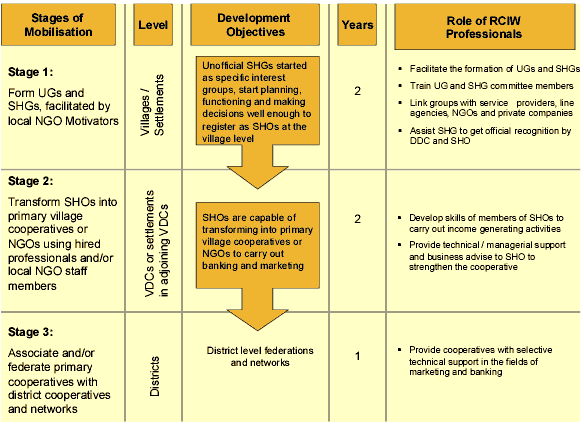
RCIW uses the social mobilisation process to facilitate the evolution of groups into self-sustaining bodies that are actively involved in making decisions, determining priorities, and implementing development activities. It develops the skills of individuals, and builds and strengthens institutions. RCIW supports the social mobilisation process in a given intervention area for up to five years. During this time, as the capacity of a user or self-help group and its members develops according to its defined goals and targets, the support provided by RCIW evolves depending on the group’s progress. RCIW’s social mobilisation process has three main stages over the five years. The earlier stages make a group’s involvement in RCIW possible, and the later stages make the group sustainable.
- Selection of the primary RCIW target group Within each selected district, RCIW concentrates its activities in one or two clusters including 5-15 VDCs. Local leaders and RCIW staff members use a transparent and participatory manner to select the most food deficit and vulnerable households. The most important selection criteria are the family and land size, income, ownership of livestock, and number of adults able to work in FfW projects. About 200-300 families are selected in each VDC as the RCIW primary target population.
- Formation of FfW User Groups (UG) RCIW offers an orientation for Besides being food insecure, families in the RCIW target population often have a low social status, little or no education, low self-esteem, and little confidence. Hence, their groups may not be sustainable or useful without substantial physical and moral support. Therefore, RCIW aims to increase the awareness and skill level of members of its target population, individually and collectively, to enable them to improve their food security situation in a sustainable way. The combination of these measures should lead to changes in the self-confidence and attitudes of the target population regarding their own social status.
- Formation of inter interest (self—help) groups The members of the FfW User Groups establish other smaller interest groups, unofficial self-help groups, to conduct activities based on the members’ own interests and abilities, such as saving and- credit, Participatory Learning and Action (PLA), and income generation. RCIW staff members facilitate this process using awareness rising techniques. The SHG members are helped to understand how the power of a group can effectively overcome social discrimination and develop self-reliance. They are made aware of their worth in the society, their development potential, and their social and economic entitlements. They also discuss the causes of the discrimination that they face whether due to gender, economic or social factors.
Human Resource Development
Besides being food insecure, families in the RCIW target population often have a low social status, little or no education, low self-esteem, and little confidence. Hence, their groups may not be sustainable or useful without substantial physical and moral support. Therefore, RCIW aims to increase the awareness and skill level of members of its target population, individually and collectively, to enable them to improve their food security situation in a sustainable way. The combination of these measures should lead to changes in the self-confidence and attitudes of the target population regarding their own social status.
- Orientation and awareness creation activities In orientation and awareness campaigns, RCIW supports Participatory Learning and Action (PLA) and Participatory Rapid Appraisal (PRA) exercises. These activities are instrumental in helping target group members to understand their current situation better and to realize their potential and limitations.
- Skill development activities RCIW supports a variety of activities to develop the skills of target groups, such as formal classroom training, on-the-job training, and exposure visits. The topics of these skill development activities relate to the main RCIW interventions in technical and non-technical fields including masonry, crop cultivation, livestock farming, childcare, nutrition, group management, account/bookkeeping, and reading and writing.
- Promoting attitudes more conducive to development RCIW focuses on promoting gender equity by implementing the “RCIW Gender Action Plan” and advocacy measures in PLA group activities. RCIW aims to leave behind local organisations that will continue the process of social mobilisation by themselves without external support. Measures to build and strengthen the institutions of the target population include:
- Training group members, especially UG committee members, in organisational matters such as financial and personnel management, resource management, principles of accountability and transparency, and the public audit system.
- Supporting groups that are similar to federate into organisations officially recognised by the District Development Committee (DDC), such as cooperatives or NGOs.
Linking groups into wider networks with organisations that provide local resources. Newly created groups During the first year, it is essential to provide intensive social mobilisation measures because new user and self-help groups usually need intensive managerial and organisational support to effectively achieve the groups’ goals. All groups, whether established for FfW projects or other objectives such as saving-and-credit, require good leadership that can be developed through RCIW training activities. RCIW also provides training to develop the necessary personnel management and bookkeeping skills.
Group graduation process
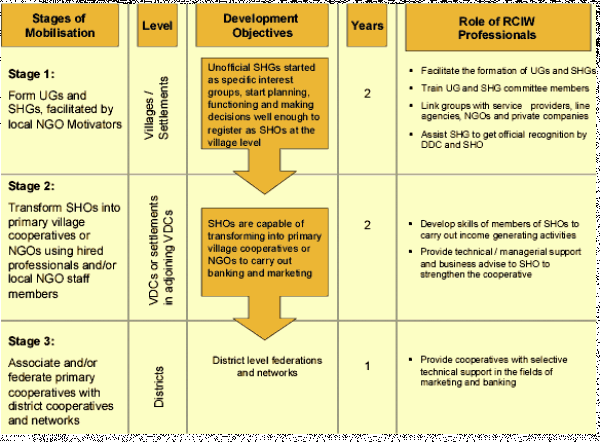
User and self-help groups should eventually become self-reliant and independent of RCIW within five years. However, experience shows that many established small self-help groups do not have sufficient capacity to provide services that satisfactorily meet the needs of their members and non-members. RCIW assists groups to network with private or government service providers in the region, such as line ministries. RCIW assists self-help groups to join existing well managed and functioning
Figure 2: Stages of development of self-help groups
|