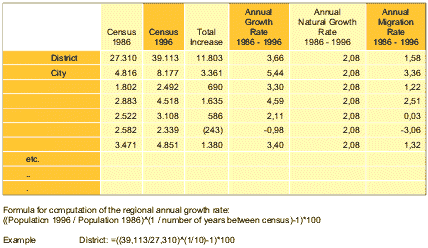
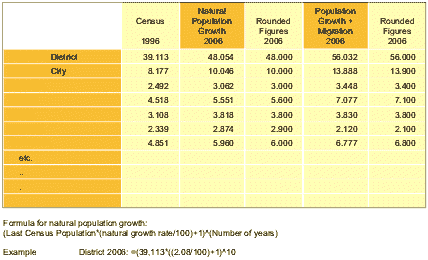
Population forecasts have been made for a District and its villages by the Regional Planning Project. Table 1 shows the computations of the existing growth rates and Table 2 shows the calculations for the population projection to 2006.
Table 1: Computation of annual growth rates
Table 2: Population Projections
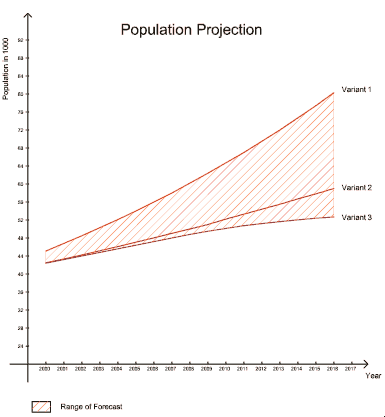
It is important to visualize the projections in order to illustrate the range of the forecast. Figure 1 shows the population projection for the District up to the year 2016.
Note the range between Variant 1 (natural population growth) and variant 2 (natural population growth plus migration). The gap between both widens over time. Unless there is a massive economic development in this district, it is unlikely that the current migration rates can be maintained. Variant 2, therefore, is absolutely the upper limit of growth.
Figure 1: Population Projection for the District
Variant 1 takes the natural growth rates of the country between 1986 and 1996. However, it is assumed, that the growth rates will slow over the years to come. Therefore, Variant 3 has been calculated with a decreasing annual population growth, down to 1.5 % in 2016.
Variant 3, therefore, is the lower limit of growth. Note that current average population growth rates in Europe vary between 0.1% (Italy) and 0.7% (Netherlands); Germany is at 0.5% growth per annum.