Defining Suitable Areas by Selection, Exclusion, Buffering and Overlay - Brief Description
|
|
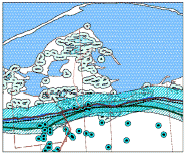
Many planning tasks can be enhanced or in some cases simplified through the use of spatially presenteddata and information using Geographical Information Systems (GIS). However, in order to be able to use the technique effectively it is important that the planner defines the criteria and appropriate procedures so that the planning information he/she wishes to generate is actually produced through the use of the GIS technique. Defining the information that should be generated by the GIS is a pre-requisite for effective use of the instrument in development planning and management. For example, if the planner wishes to determine areas that are particularly prone to soil erosion, the factors that are common causes of soil erosion need to be known. Soil erosion could depend upon the slope (i.e. the steeper the slope the higher the probability of erosion). A further cause could also be the intensity of precipitation (i.e. the higher the precipitation, the higher the probability of erosion). Further factors could be soil types (i.e. sandy soils may be more prone to erosion) as well the vegetation cover (i.e. grass cover tends to be less prone to soil erosion compared to areas covered by eucalyptus trees). If the information is presented spatially (i.e. on thematic maps) these maps can be overlayed and the planner is better able to determine the soil erosion prone areas. While the GIS technique helps in depicting the final information the planner still has to decide in advance what factors cause soil erosion and how the combination of different factors are interrelated with each other. Map 1: Using GIS, a combination of selected, excluded and buffered map features lead to a desired result
|